5 Red Flags to Watch Out For When Hiring a Solar Company in Nigeria
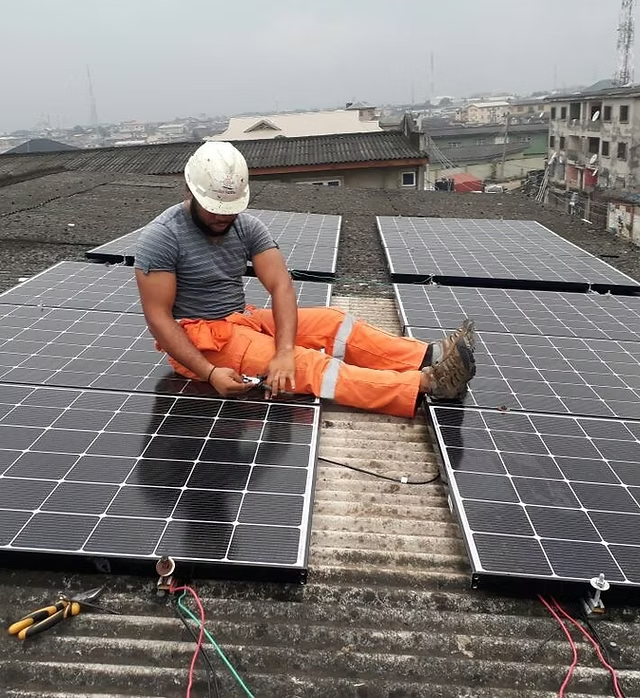
Depending on the size of your home, your electricity needs and the equipment you choose, you could spend hundreds of thousands or several millions of naira on a solar system.
Going solar in Nigeria is a serious investment.
Depending on the size of your home, your electricity needs and the equipment you choose, you could spend hundreds of thousands or several millions of naira on a solar system.
And while the panels, inverter and batteries matter, there is something else you need to take seriously:
Who is installing the system?
A good solar company can design and install a system that works reliably for years. A bad installer can leave you with an expensive setup that doesn't give you the power you expected.
The difficult part is that many solar companies can make a quotation look impressive. They can mention kVA, kWh, lithium batteries, 550W panels and MPPT controllers until you are confused.
So how do you know who to trust?
Here are five red flags to watch out for when hiring a solar company in Nigeria.
1. They Recommend a System Without Checking Your Load
This is one of the biggest warning signs.
You tell an installer:
"I need solar for my house."
And before asking you anything else, they say:
"You need 5kVA."
But how did they arrive at 5kVA?
A proper solar installation should begin with your actual electricity needs.
The installer should want to know what appliances you have, how much power they consume, how long you use them and which appliances you want to keep running during a blackout.
Your refrigerator is not the same as your air conditioner.
Your TV is not the same as your water pump.
Your fan is not the same as your electric cooker.
A serious installer should assess your load before recommending an inverter, battery and number of solar panels.
What should you ask?
Ask:
"Can you show me the load assessment you used to design this system?"
If the installer cannot explain why they recommended the system they are selling you, take a step back.
Your solar system should be designed around your home, not around whatever equipment the installer currently has in stock.
2. They Promise You "24/7 Electricity" Without Asking Questions
Be careful when a salesperson tells you:
"This system will give you 24 hours light."
Or:
"You will never need NEPA again."
It sounds good, but electricity doesn't work that way.
How long your solar system can power your home depends on several things, including your load, battery capacity, solar generation, weather and how you use your appliances.
There is a massive difference between powering:
- Four fans
- A refrigerator
- Lights
- Wi-Fi
- TV
- Phones
and powering:
- Two air conditioners
- Electric cooker
- Water heater
- Washing machine
- Water pump
- Fridge and freezer
- Multiple TVs
The second home needs a much larger system.
So instead of asking:
"Will this give me 24 hours light?"
Ask:
"How long will the battery run my essential loads without solar input?"
A professional installer should be able to explain this using actual numbers.
3. They Won't Give You the Exact Equipment Models
Another red flag is a quotation that simply says:
5kVA inverter — ₦XXX
10kWh lithium battery — ₦XXX
550W solar panels — ₦XXX
That's not enough information.
There are many inverter, battery and solar panel brands in the Nigerian market, and products with the same basic capacity can have very different specifications, warranties and expected performance.
Before paying, you should know exactly what you are buying.
A proper quotation should identify things such as:
- Brand
- Exact model
- Capacity
- Quantity
- Important specifications
- Warranty
- Installation scope
For example, if a company quotes a 550W solar panel, you should be able to find out the manufacturer and exact model.
You should not have to ask:
"Which one exactly?"
and hear:
"Don't worry, it's a very good panel."
You are spending your money. You deserve to know what you are buying.
4. Their Price Is Suspiciously Cheap
Everyone wants a good deal.
But with solar, the cheapest quotation is not necessarily the best deal.
Imagine you receive three quotations:
Company A: ₦4.8 million Company B: ₦5.2 million Company C: ₦2.8 million
Naturally, Company C gets your attention.
But before you rush to pay, compare what is actually included.
Maybe the ₦2.8 million quotation has:
- A smaller battery
- Fewer solar panels
- A cheaper inverter
- Lower-quality cables
- No proper surge protection
- Minimal mounting equipment
- Little or no after-sales support
Now you aren't comparing three versions of the same solar system.
You are comparing three completely different packages.
Compare the specifications, not just the price.
Ask every company to break down the quotation:
Panels: Brand, model, wattage and quantity
Inverter: Brand, model and capacity
Battery: Brand, model, chemistry and usable capacity
Protection: Breakers, surge protection and earthing
Mounting: Materials and installation
Labour: Installation and commissioning
Warranty: Equipment and workmanship
Once everything is written down, the price comparison becomes much more meaningful.
5. They Don't Have a Proper Warranty or After-Sales Support
This one is extremely important.
Imagine spending ₦5 million on a solar system and three months later the inverter develops a problem.
You call the installer.
No answer.
You send WhatsApp messages.
"Seen."
You call again.
"Boss, we'll get back to you."
That is not the kind of support you want after making a multi-million-naira investment.
Before you pay, ask:
- What is the inverter warranty?
- What is the battery warranty?
- What warranty comes with the panels?
- Is installation covered?
- Who handles warranty claims?
- Where do I go if there is a fault?
- How quickly can a technician respond?
- Is the system monitored after installation?
A solar company shouldn't disappear after collecting your money.
Installation is not the end of the relationship.
It should be the beginning of proper after-sales support.
So, How Do You Choose the Right Solar Company?
Before hiring anyone, do a little homework.
Ask to see previous installations.
Ask about the equipment they use.
Get at least two or three quotations.
Compare the actual specifications.
Ask technical questions.
And, most importantly, pay attention to how the company communicates with you.
If an installer patiently explains the system, shows you the numbers and tells you what the system can and cannot do, that's a much better sign than someone who simply tells you:
"Don't worry, boss. This one will carry everything."
This Is Where DB Energy Comes In
At DB Energy, the approach is straightforward: your solar system should be designed around your actual energy needs.
DB Energy provides solar installation, solar panels, inverter solutions, battery storage, maintenance and solar consultation for homes, businesses and industrial customers across Nigeria.
Instead of simply selling you a collection of panels and batteries, the process starts with understanding the property and the energy requirement.
DB Energy's stated process includes a site survey, system design, professional installation, testing and handover. The company says its team assesses factors such as energy needs, roof space and sunlight exposure before designing the system.
That matters because your solar system should fit your life.
If you need backup for your fridge, fans, lights, internet and work equipment, your system should be designed around those loads.
If you run a business that needs substantially more power, the system should be designed accordingly.
DB Energy also provides residential, commercial and industrial solar solutions, rather than taking a one-size-fits-all approach. Its commercial systems currently cover projects from 15kW to 150kW, with options for grid and generator integration, monitoring and ongoing maintenance.
Quality Equipment Matters Too
A solar company can have good engineers and still give you a poor system if the equipment is not up to standard.
DB Energy currently lists products including Tier-1 550W monocrystalline solar panels, a 5kW hybrid inverter and 48V 200Ah LiFePO₄ batteries, alongside mounting equipment and other solar accessories.
The company also states that its solar panels carry a 25-year performance warranty, with 5–10 years of coverage available on certain inverter and battery products. Always confirm the specific warranty applicable to the equipment in your quotation before purchase.
And It Doesn't End After Installation
This is one of the things homeowners should consider before choosing a solar installer.
Solar systems need attention over time.
Panels may need cleaning. Batteries need monitoring. Inverters can develop faults. Connections and protection equipment may need inspection.
DB Energy offers solar maintenance and says its systems can be monitored remotely, allowing issues to be identified before they become bigger problems.
DB Energy currently serves several Nigerian locations, including Lagos, Enugu, Asaba, Abuja, Port Harcourt, Benin City, Onitsha, Owerri and Warri, according to its location information.
Don't Let a Solar Salesperson Rush You
You don't have to understand every technical detail before buying solar.
But you should understand what you're paying for.
Ask questions.
Compare quotations.
Check the equipment.
Understand the battery capacity.
Know what appliances the system is designed to run.
Ask about warranties.
And make sure there is someone you can call when something goes wrong.
The right solar company shouldn't make you feel like you are disturbing them by asking questions.
They should be happy to explain.
Ready to Go Solar?
If you are tired of depending on your generator, dealing with fuel costs or constantly worrying about the next power outage, the next step is simple.
Let DB Energy assess your energy needs and design a solar system around your home or business.
DB Energy offers a free, no-obligation consultation and site assessment, followed by a detailed system design and quotation. The company's quote process says enquiries are reviewed within 24 hours before a consultant discusses the project and schedules the assessment.
Don't guess your solar system. Get it properly designed.
Get Your Free Solar Quote from DB Energy →
Prices, equipment availability and solar requirements vary from one project to another. Always request a detailed quotation and confirm the exact equipment, warranty and installation scope before making payment.
Ready to Go Solar?
Get a free, no-obligation solar quote today. Our team will design a solar system tailored to your home or business.